

Understanding the SEC's role for US expats in Europe 2026
- 4 days ago
- 10 min read

Moving to Europe as a US expat often brings the assumption that American financial regulators no longer apply to your investments. Many expats mistakenly believe the Securities and Exchange Commission’s oversight ends at US borders. The reality is strikingly different. The SEC’s jurisdiction follows you abroad, shaping how you invest, which securities you can access, and what compliance obligations you must meet. This guide clarifies the SEC’s specific responsibilities affecting US expats in Europe, helping you navigate cross-border investing whilst maintaining full regulatory compliance and avoiding costly penalties.
Table of Contents
Key takeaways
Point | Details |
SEC jurisdiction is global | The SEC regulates all US persons worldwide, including expats residing in Europe, ensuring investor protection across borders. |
FATCA and SEC work together | Whilst FATCA mandates foreign asset reporting to the IRS, SEC rules govern securities transactions and disclosures. |
European PRIIPs restrict access | EU regulations limit US-domiciled ETFs for European residents, creating investment challenges for compliant expats. |
Non-compliance carries penalties | Failing to meet SEC and IRS requirements results in substantial fines and potential investment restrictions. |
Regulated advisers are essential | Working with professionals experienced in both SEC and European rules ensures compliant wealth management. |
The SEC’s regulatory role for US expats investing in Europe
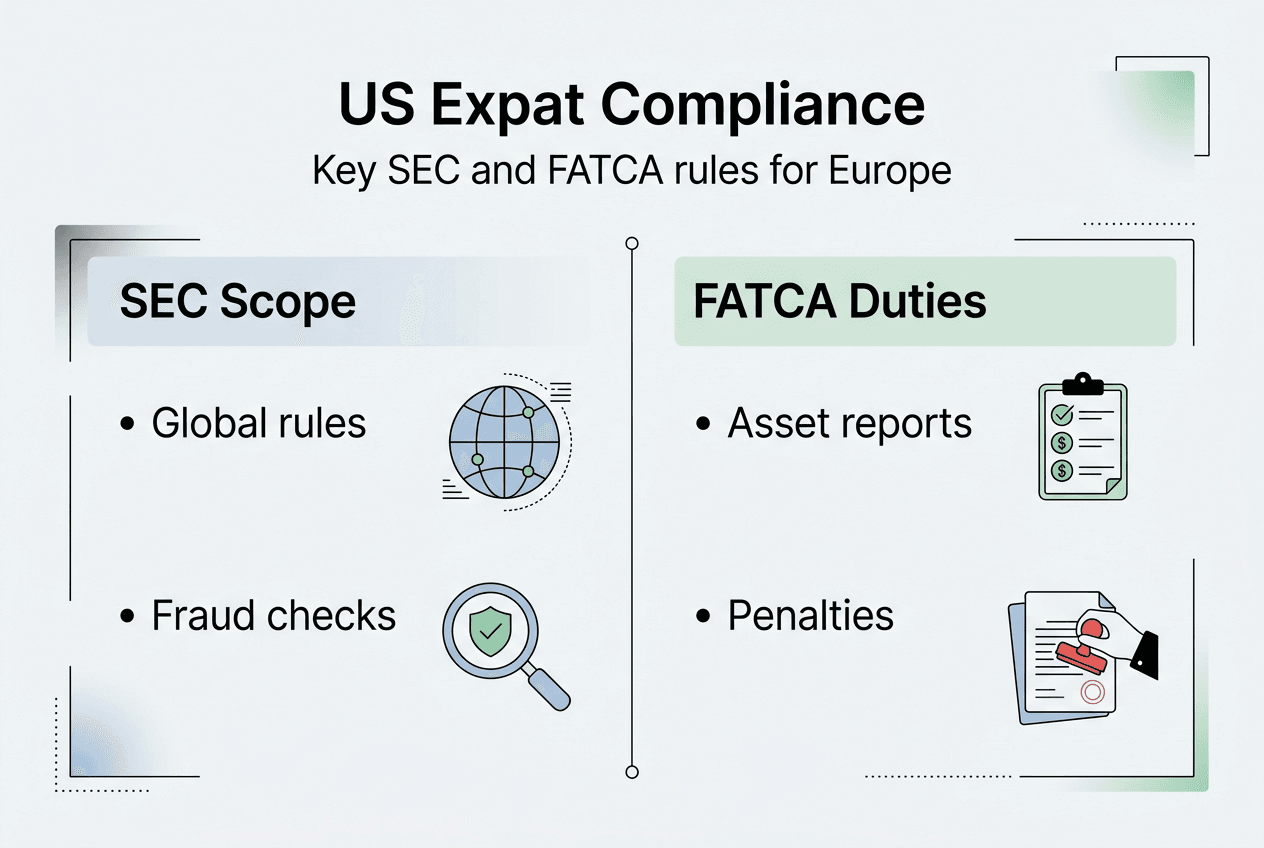
The Securities and Exchange Commission maintains authority over all US citizens and residents, regardless of where they physically live. This means your European address does not exempt you from SEC regulations governing securities transactions, investment disclosures, and broker-dealer relationships. The SEC’s primary mission centres on protecting investors through mandatory disclosure requirements and preventing fraudulent practices in securities markets.
For US expats, this regulatory reach creates a dual compliance landscape. You remain subject to American securities laws whilst simultaneously navigating European financial regulations in your country of residence. The SEC enforces rules about which securities offerings you can participate in, how investment products must be disclosed to you, and what protections you receive as an investor. The SEC enforces securities laws that impact US citizens globally, including abroad, ensuring consistent investor protection standards.
Understanding financial regulation for US expats requires recognising that SEC oversight complements rather than replaces local European rules. The Commission works alongside European regulators but maintains distinct requirements that can affect your investment choices. These parallel systems sometimes create conflicts, particularly regarding product availability and reporting obligations.
Key SEC responsibilities affecting expats include:
Regulating securities offerings marketed to US persons abroad
Enforcing disclosure requirements for investment products
Overseeing broker-dealers serving American clients overseas
Investigating fraudulent schemes targeting expat investors
Coordinating with foreign regulators on cross-border enforcement
The SEC’s role extends beyond simple oversight. It actively investigates investment fraud targeting Americans abroad, prosecutes violations of securities laws, and maintains registration requirements for financial professionals serving US clients. Your status as an expat does not reduce these protections or obligations. The Commission’s enforcement actions regularly include cases involving Americans living overseas who violated securities regulations or fell victim to unregistered investment schemes.
This regulatory framework aims to ensure you receive the same investor protections abroad as you would in the United States. However, it also means you cannot simply adopt European investment practices without considering American compliance requirements. The intersection of SEC rules with local European regulations creates complexity that requires careful navigation and often professional guidance.
How SEC regulations intersect with IRS FATCA and European compliance for expats
The Foreign Account Tax Compliance Act represents a separate but related compliance requirement for US expats. FATCA requires US citizens abroad to report foreign financial assets, with substantial penalties for non-compliance. Whilst FATCA focuses on tax enforcement through the IRS, SEC regulations concentrate on securities transactions and investor protection. These two regulatory frameworks operate independently but often affect the same financial activities.
Understanding this intersection proves crucial for maintaining full compliance. FATCA mandates that you report foreign bank accounts, investment accounts, and certain other financial assets annually if they exceed specified thresholds. The SEC, meanwhile, regulates the securities you hold in those accounts, the advisers managing them, and the transactions you execute. Both agencies can impose penalties independently, meaning a single investment decision might trigger compliance obligations with multiple regulators.
European regulations add another layer of complexity through the Packaged Retail and Insurance-based Investment Products framework. PRIIPs rules require detailed disclosures for investment products marketed to EU residents, including key information documents that many US-domiciled funds have not prepared. This regulatory gap effectively restricts European residents, including US expats, from purchasing many American ETFs and mutual funds through European brokers.
The compliance coordination required includes:
Filing annual FATCA reports through Form 8938 with your tax return
Ensuring any securities purchases comply with both SEC and PRIIPs requirements
Verifying that investment advisers hold appropriate licences in both jurisdictions
Maintaining documentation that satisfies American and European record-keeping standards
Understanding how each regulatory framework defines reportable assets and transactions
“Navigating cross-border regulations requires understanding that compliance with one framework does not guarantee compliance with others. Each regulatory body maintains distinct requirements and enforcement mechanisms.”
The practical impact of these intersecting regulations affects your daily financial decisions. Opening a brokerage account in Europe requires providing documentation to satisfy both local know-your-customer rules and FATCA reporting requirements. Purchasing securities means verifying they comply with PRIIPs rules whilst ensuring the transaction does not violate SEC regulations. Working with financial advisers demands confirming they hold proper credentials recognised by relevant authorities in both jurisdictions.

Failure to coordinate these compliance requirements creates significant risks. The IRS imposes penalties starting at $10,000 for failing to file required FATCA reports, with additional penalties for continued non-compliance. The SEC can pursue enforcement actions for securities violations, potentially including fines, disgorgement of profits, and trading restrictions. European regulators may impose their own penalties for violations of local investment rules. Understanding international tax planning for US expats helps coordinate these obligations effectively.
Navigating investment options under SEC and European regulations
The regulatory landscape creates practical constraints on which investments US expats can access whilst living in Europe. US-domiciled ETFs and mutual funds represent a primary challenge. These popular investment vehicles typically lack the key information documents required by PRIIPs regulations, making them unavailable through most European brokers serving EU residents. This restriction applies regardless of your American citizenship, as European brokers must comply with local rules governing all clients.
Some brokers have attempted to circumvent these restrictions by allowing EU residents to purchase US-domiciled ETFs. European brokers allowing US-domiciled ETFs to European residents may be non-compliant with PRIIPs, risking future audit problems and potential account restrictions. Using such services creates compliance risks that could result in forced liquidation of positions or loss of access to your investments.
Alternative investment options for compliant expats include:
European-domiciled ETFs tracking similar indices to US funds
UCITS-compliant investment vehicles meeting EU standards
Individual securities purchased directly through compliant brokers
Managed accounts with advisers holding appropriate cross-border licences
Pension products structured to comply with both US and European rules
Pro Tip: Before opening any investment account in Europe, verify that the broker or platform explicitly serves US citizens and understands FATCA reporting obligations. Many European financial institutions refuse American clients due to compliance complexity.
Comparing investment options requires understanding key differences:
| Feature | US-domiciled funds | European UCITS funds | Individual securities | | — | — | — | | PRIIPs compliance | Generally non-compliant | Fully compliant | Not applicable | | Availability to EU residents | Restricted by most brokers | Widely available | Available through compliant brokers | | US tax treatment | Straightforward reporting | May involve PFICs complexities | Direct reporting | | Expense ratios | Often lower | Typically higher | Transaction costs vary |
The choice between regulated investment examples for US expats involves balancing accessibility, cost, tax efficiency, and compliance certainty. European UCITS funds offer regulatory compliance but may trigger passive foreign investment company rules under US tax law, creating additional reporting burdens and potentially unfavourable tax treatment. Individual securities avoid PFIC complications but require more active management and research.
Working with advisers who understand both regulatory frameworks proves essential. Your adviser should hold appropriate licences recognised by relevant authorities in your European country of residence whilst understanding SEC rules and US tax implications. Compliance in financial advice for US expats ensures recommendations account for all applicable regulations rather than focusing solely on returns or European market practices.
The risks of non-compliant investments extend beyond immediate penalties. Holding securities through platforms that violate PRIIPs rules may result in forced account closures, requiring you to liquidate positions at unfavourable times. Using unregistered advisers eliminates investor protections and recourse mechanisms if disputes arise. Building a compliant investment strategy from the outset avoids these complications whilst maintaining access to appropriate wealth-building opportunities.
Practical compliance tips for US expats dealing with the SEC and cross-border regulations
Maintaining compliance across multiple regulatory frameworks requires systematic record-keeping and proactive monitoring. Start by establishing a comprehensive filing system that tracks all foreign financial accounts, securities transactions, and advisory relationships. Document account opening dates, maximum balances, transaction histories, and any income generated. This information supports both FATCA reporting to the IRS and potential SEC inquiries about your investment activities.
Working with properly regulated advisers represents your most important compliance safeguard. Verify that any financial professional you engage holds current licences from relevant regulatory bodies in both your European country of residence and, where applicable, US credentials. Check registration status through official databases rather than relying solely on adviser representations. The consequences of using unregistered or improperly licensed advisers include loss of investor protections and potential liability for compliance violations.
Key verification steps include:
Confirming adviser registration with local European financial regulators
Checking SEC registration for advisers claiming US credentials
Verifying professional certifications through issuing organisations
Reviewing disciplinary histories and client complaints
Understanding fee structures and potential conflicts of interest
Pro Tip: Request written confirmation of an adviser’s regulatory status and professional indemnity insurance before engaging their services. Legitimate professionals readily provide this documentation.
Understanding reporting deadlines prevents costly penalties. FATCA reporting through Form 8938 accompanies your annual US tax return, typically due in April with available extensions. Significant penalties result from failing to comply with FATCA and SEC reporting requirements, starting at $10,000 for missed filings and escalating for continued non-compliance. The SEC maintains separate reporting requirements for certain large investors and insiders, with distinct deadlines and filing procedures.
Monitoring regulatory changes ensures ongoing compliance as rules evolve. Both SEC regulations and European financial rules undergo periodic updates that may affect your investment options or reporting obligations. Subscribe to regulatory updates from relevant authorities, work with advisers who maintain current knowledge of rule changes, and review your compliance procedures annually to identify any necessary adjustments.
Verifying financial credentials for US expats protects you from fraudulent schemes and ensures your advisers can provide appropriate guidance. The complexity of cross-border regulations creates opportunities for unscrupulous operators to exploit expat confusion. Confirming credentials through official channels eliminates this risk whilst ensuring you receive advice from qualified professionals.
Consider investment suitability for US expats when evaluating recommendations. Suitable investments account for your specific circumstances, including tax status, risk tolerance, time horizon, and regulatory constraints. An investment appropriate for a European resident may create compliance problems or tax inefficiencies for a US expat. Your adviser should explicitly address how recommendations accommodate your dual regulatory environment.
Regular compliance reviews help identify potential issues before they escalate. Schedule annual meetings with your tax adviser and financial professional to review account holdings, verify reporting completeness, and assess whether your investment strategy remains compliant with current regulations. This proactive approach costs less than addressing compliance failures after regulators identify problems.
Get expert financial guidance for US expats in Europe
Navigating the complex intersection of SEC regulations, IRS requirements, and European financial rules demands specialised expertise. The compliance challenges facing US expats require advisers who understand both American and European regulatory frameworks, can structure investments to satisfy all applicable rules, and maintain current knowledge of evolving requirements.
[

Link Independent connects US expats throughout Europe with trusted financial advice for US expats who specialise in cross-border wealth management. Our network includes regulated professionals experienced in SEC compliance, FATCA reporting, and European investment regulations. Whether you need guidance on structuring compliant investments, coordinating tax obligations across jurisdictions, or verifying the credentials of potential advisers, we match you with experts who understand your unique situation. Our three-step process ensures you receive personalised recommendations rather than generic advice, connecting you with professionals who can navigate the regulatory complexity whilst helping you build wealth effectively.
FAQ
What is the specific role of the SEC for US expats living in Europe?
The SEC regulates securities offerings and transactions involving all US persons worldwide, including expats residing in Europe. It ensures investor protection through mandatory disclosure requirements and enforces rules preventing fraudulent investment schemes. The Commission’s jurisdiction does not end at American borders, meaning expats remain subject to US securities laws regardless of their physical location.
How does FATCA complement SEC regulations for US expats?
FATCA requires US citizens abroad to report foreign financial assets to the IRS, focusing on tax enforcement and preventing offshore tax evasion. The SEC concentrates on securities regulation, investor protection, and market integrity. Whilst these frameworks operate independently, they often affect the same financial activities, requiring expats to maintain compliance with both simultaneously.
Can US expats invest in US-domiciled ETFs whilst residing in Europe?
Most European brokers restrict EU residents, including US expats, from purchasing US-domiciled ETFs due to PRIIPs regulations requiring key information documents. Some brokers allow these purchases despite potential non-compliance, creating risks of future account restrictions or forced liquidations. European-domiciled UCITS funds offer compliant alternatives, though they may trigger different US tax considerations.
What steps can US expats take to ensure compliance with SEC and European regulations?
Work with regulated advisers holding appropriate licences in both jurisdictions and experienced in cross-border compliance. Maintain comprehensive records of all foreign financial accounts and securities transactions. Meet all IRS and SEC reporting deadlines, verify credentials of financial professionals through official databases, and conduct annual compliance reviews to identify potential issues before they escalate into regulatory problems.
Recommended
Comments