

Why Use Independent Financial Advisers: Real Benefits
- Dec 16, 2025
- 7 min read

Nearly half of British adults seek professional advice when making major financial decisions, yet many overlook the importance of independence in their adviser. With so many options across the British financial services sector, it becomes crucial to understand how true independence impacts unbiased recommendations and client protection. This guide breaks down what truly defines an Independent Financial Adviser and why the right choice could significantly shape your financial future.
Table of Contents
Key Takeaways
Point | Details |
Independence of Advisers | Independent Financial Advisers provide unbiased advice by accessing the entire market, free from product provider restrictions. |
Comprehensive Services | Their offerings include retirement planning, investment management, tax optimisation, and estate planning, addressing complex financial needs. |
Fiduciary Responsibility | Independent advisers prioritise clients’ best interests, contrasting with tied advisers who may be influenced by product commissions. |
Regulatory Compliance | Ongoing professional qualifications and adherence to ethical standards ensure that clients receive transparent and responsible financial guidance. |
What Defines an Independent Financial Adviser?
An Independent Financial Adviser represents a professional category with remarkable autonomy in financial guidance. Unlike traditional financial representatives tied to specific product providers, these specialists offer comprehensive, unbiased recommendations tailored precisely to individual client needs.
According to the Association of British Insurers, an Independent Financial Adviser is a qualified professional who provides impartial advice across multiple financial domains, including life insurance, pensions, and investment products. Their fundamental distinguishing characteristic is the ability to recommend solutions from the entire market landscape, rather than being restricted to a limited product range.
Key defining characteristics of an Independent Financial Adviser include:
Complete market access without product restrictions
Legally mandated requirement to recommend the most suitable financial solutions
Comprehensive understanding of diverse financial instruments
Fiduciary responsibility to prioritise client interests
Professional qualifications and ongoing regulatory compliance
These professionals operate with a strategic approach, analysing individual financial circumstances, risk tolerances, and long-term objectives. They are not commission-driven salespeople but strategic partners who construct holistic financial strategies designed to maximise client wealth and security.
Pro Tip: Always verify an Independent Financial Adviser’s regulatory credentials before engaging their services, ensuring they are fully authorised and possess current professional certifications.
Types of Financial Adviser Services Offered
Financial advisers offer a comprehensive spectrum of services designed to address complex, multifaceted financial challenges for individuals and businesses navigating intricate global financial landscapes. These services extend far beyond simple investment recommendations, encompassing strategic planning, risk management, and holistic wealth preservation strategies.
The primary service categories provided by Independent Financial Advisers typically include:
Retirement Planning
Pension strategy development
Retirement income projection
Superannuation and international pension transfers
Investment Management
Portfolio construction
Asset allocation strategies
Risk-adjusted investment recommendations
Tax Optimisation
Cross-border taxation planning
Investment tax efficiency strategies
International wealth structuring
Estate and Wealth Preservation
Inheritance tax planning
Wealth transfer strategies
Trust and legal structure recommendations
Each service is meticulously tailored to individual client circumstances, considering unique factors such as international residency, multi-jurisdictional financial interests, risk tolerance, and long-term financial objectives. Sophisticated clients require nuanced approaches that transcend traditional financial advisory models.
These professionals leverage advanced analytical tools and deep regulatory understanding to craft bespoke financial solutions. They navigate complex international financial regulations, ensuring clients receive strategically optimised recommendations that align with global compliance standards.
Pro Tip: Request a comprehensive service scope document from your financial adviser, detailing exactly which services are included, ensuring complete transparency about the support you will receive.
How the Independence Model Ensures Unbiased Advice
The independence model represents a revolutionary approach to financial advisory services, fundamentally designed to eliminate conflicts of interest and prioritise client outcomes above all other considerations. Unlike traditional financial representatives who might be incentivised by product commissions or corporate targets, independent financial advisers operate under a strict ethical framework that places client interests at the absolute forefront of their professional practice.
Key mechanisms that guarantee unbiased advice include:
Comprehensive market research across all available financial products
Absence of restrictive ties to specific financial institutions
Legally mandated disclosure of potential conflicts of interest
Transparent fee structures not dependent on product sales
Regulatory oversight ensuring professional conduct
Independent financial advisers are legally obligated to recommend solutions that represent the most appropriate match for a client’s unique financial landscape. This means they can evaluate products from multiple providers, comparing intricate details such as fee structures, performance histories, risk profiles, and potential tax implications without being constrained by corporate allegiances.

The rigorous professional standards governing independent financial advice create a protective ecosystem for clients. Advisers must maintain ongoing professional qualifications, undergo regular compliance checks, and demonstrate an unwavering commitment to ethical practice. This systematic approach ensures that recommendations are driven by sophisticated analytical assessment rather than sales targets or institutional preferences.
Pro Tip: Request a written conflict of interest declaration from your financial adviser, which should comprehensively outline any potential professional relationships that might influence their recommendations.
Global Regulations and Adviser Qualifications
The landscape of global financial advisory regulations represents an intricate network of stringent professional standards designed to protect investors and maintain the highest levels of financial service integrity. Professional qualifications in financial advisory services are no longer simply academic credentials, but comprehensive regulatory certifications that demand continuous professional development, ethical commitment, and sophisticated technical expertise.
Key regulatory requirements for financial advisers typically encompass:
Mandatory Professional Certifications
Advanced diploma-level financial planning qualifications
Ongoing professional education credits
Specialist cross-border investment certification
Regulatory Compliance
Regular compliance audits
Comprehensive background security checks
Mandatory professional indemnity insurance
Ethical Standards
Fiduciary responsibility declarations
Transparent fee structure reporting
Comprehensive conflict of interest disclosures
Each jurisdiction maintains unique regulatory frameworks, but international professional bodies increasingly collaborate to establish consistent global standards. This approach ensures that financial advisers can demonstrate competence, integrity, and client-focused service regardless of geographical boundaries. Sophisticated investors require professionals who understand complex multi-jurisdictional financial regulations, can navigate intricate tax implications, and provide strategic guidance across different economic environments.
The most respected financial advisers invest significantly in their professional development, maintaining certifications that go beyond basic regulatory requirements. They continuously update their knowledge of global financial markets, emerging investment technologies, and evolving regulatory landscapes to provide clients with cutting-edge, strategically nuanced financial advice.
Explore how key regulatory standards protect clients and enhance advisory quality:
Regulatory Standard | Client Benefit | Adviser Requirement |
Mandatory Certification | Assurance of adviser expertise | Continuous qualification updates |
Compliance Audits | Reduces risk of malpractice | Undergo regular regulatory checks |
Ethical Declarations | Increases advice transparency | Disclose conflicts of interest |
Indemnity Insurance | Compensation for client losses | Maintain sufficient cover at all times |
Pro Tip: Request a detailed breakdown of your financial adviser’s professional qualifications, including their current regulatory registrations and most recent professional development achievements.
Risks, Costs, and Benefits Compared to Tied Advice
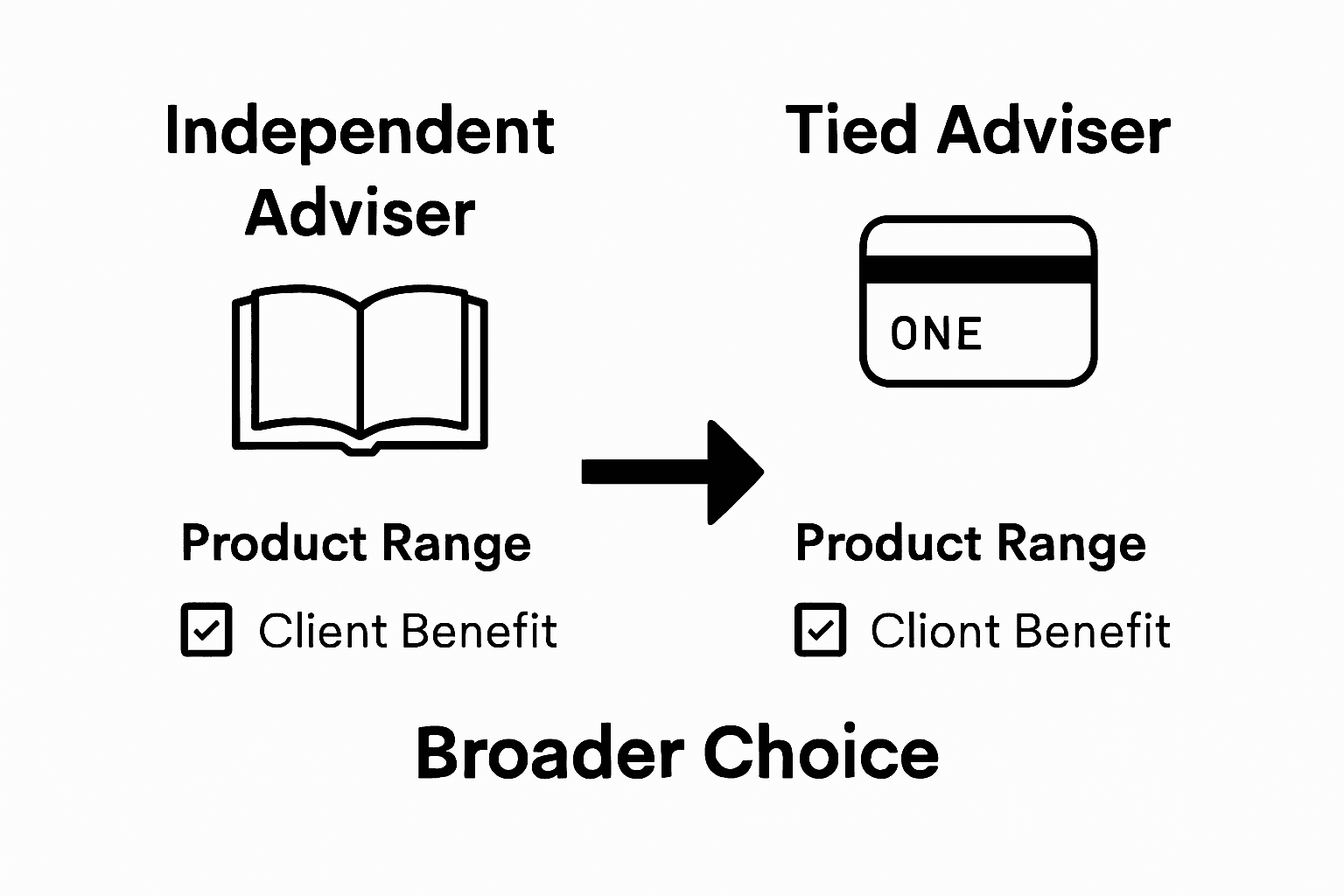
Navigating the complex landscape of financial advice requires a nuanced understanding of the fundamental differences between independent and tied financial advisory models. While tied advisers represent specific financial institutions with limited product ranges, independent financial advisers offer a comprehensive approach that prioritises client outcomes over institutional constraints.
According to research on financial advisory practices, independent financial advisers operating on their own licenses are responsible for the advice they provide, with mandatory professional indemnity insurance that can compensate clients for potential financial losses resulting from negligent advice. This critical protection distinguishes them from tied advisers who may have more restrictive accountability mechanisms.
Key comparative elements include:
Product Accessibility
Independent: Full market access
Tied: Limited to specific institutional products
Cost Structures
Independent: Transparent, often fee-based
Tied: Commission-driven, potential hidden charges
Risk Management
Independent: Comprehensive risk assessment
Tied: Potentially compromised by institutional interests
Compensation Model
Independent: Client-centric fee arrangements
Tied: Sales-driven commission structures
The financial risks associated with tied advice can be substantially higher, as advisers may be incentivised to recommend products that generate the highest institutional commissions rather than those most suitable for individual client needs. Independent advisers, by contrast, maintain a fiduciary responsibility that legally mandates recommendations based purely on client interests.
Here is a concise comparison of independent and tied financial advisers:
Criterion | Independent Adviser | Tied Adviser |
Product Range | Entire market considered | Limited to selected provider |
Compensation Model | Transparent fees, client-focused | Commission-based, provider-driven |
Regulatory Protection | Professional indemnity required | Often only covered by employer policies |
Client Focus | Fiduciary duty prioritised | May face institutional pressures |
Pro Tip: Request a comprehensive fee breakdown and conflict of interest declaration from any financial adviser before engaging their services, ensuring complete transparency about potential recommendation biases.
Discover Truly Independent Financial Guidance Tailored to You
The article highlights challenges faced by individuals and businesses managing complex, cross-border financial matters who seek unbiased, comprehensive advice from fully qualified Independent Financial Advisers. Key concerns like transparency in fee structures, access to the entire market, and fiduciary responsibility resonate deeply with those aiming for long-term wealth preservation and risk mitigation. The pain of navigating tied advice with limited product ranges and potential conflicts of interest is evident.
At Linkindependent.com, we eliminate these obstacles by connecting you to verified financial professionals worldwide committed to independence and transparency. Whether your needs involve international wealth planning, tax optimisation, or investment management, our platform offers a personalised service that respects your unique financial landscape. Benefit from access to advisers with global regulatory compliance and clear fee disclosures, ensuring your best interests are always prioritised.
Explore the difference true independence makes when you partner with experts on Linkindependent.com. Take control of your financial future today by defining your needs, finding your match, and scheduling free consultations effortlessly.

Ready to break free from restricted advice and complex financial jargon? Visit Linkindependent.com now and connect with Independent Financial Advisers who put your interests first, every step of the way.
Frequently Asked Questions
What are the benefits of using an Independent Financial Adviser?
Independent Financial Advisers provide unbiased financial guidance by accessing the entire market and prioritising clients’ unique needs. They offer tailored strategies, ensuring clients receive the best advice without conflicts of interest.
How do Independent Financial Advisers ensure they provide unbiased advice?
Independent Financial Advisers operate under a strict ethical framework that requires them to conduct comprehensive market research, maintain transparent fee structures, and disclose any potential conflicts of interest. This independence guarantees that their recommendations are in the client’s best interest.
What services can I expect from an Independent Financial Adviser?
Independent Financial Advisers offer a variety of services, including retirement planning, investment management, tax optimisation, and estate planning. Each service is customised based on the client’s financial situation and objectives.
How are Independent Financial Advisers regulated?
Independent Financial Advisers must comply with stringent regulatory standards, including mandatory professional certifications, regular compliance audits, and ongoing professional development. This ensures they maintain high levels of expertise and ethical conduct.
Recommended
Comments